Ehlers-Danlos syndrome.
Chiropractic care for Ehlers-Danlos syndrome and hypermobility in Jacksonville. Gentle, low-force care and stabilization rehab for loose, painful joints, plus functional medicine for the gut and fatigue that come with it.
Loose joints need stability, not more stretching.
Yes, we help people with Ehlers-Danlos syndrome (EDS) and hypermobility spectrum disorder at our Southside Jacksonville and Orange Park offices. Our chiropractors use gentle, low-force care and stabilization rehab for the joints, and our functional medicine team works on the gut, energy, and hormone problems that so often come along with EDS.
EDS is a group of inherited conditions that affect collagen, the protein that gives ligaments, skin, and other tissues their strength. Hypermobile EDS (hEDS) is the most common type. When ligaments are loose, joints move further than they should, muscles work overtime to hold them in place, and pain shows up in the hips, SI joints, back, neck, and shoulders.
You cannot change your collagen. You can change how well your muscles support your joints, and how much inflammation, gut trouble, and fatigue you carry. That is where we focus.
What EDS often feels like
How we help with EDS.
Why people with EDS hurt in the hips, SI joints, and psoas
The pelvis is held together mostly by ligaments. When those ligaments are loose, the SI joints and hips shift more than they should with every step, every stair, and every time you stand up.
Your body protects itself by tightening the muscles that cross those joints, especially the psoas and hip flexors at the front of the hip and the muscles around the low back. That constant guarding is tiring and painful, and it often gets mistaken for a simple tight muscle.
Stretching a guarding muscle feels good for a minute, then it tightens right back up, because the joint still is not stable. The lasting fix is giving the deep core and hip muscles the strength to hold the pelvis steady, so the psoas no longer has to.
How chiropractic care is different for hypermobile joints
Most people with EDS have a mix: some joints that move too much and a few that are stiff and stuck. The exam sorts out which is which.
Stiff, irritated segments get gentle, low-force care. Joints that already move too much do not get forceful manipulation. They get stability work instead.
Most of your plan is active: controlled strength exercise, joint position training, and a short routine you can do at home on good days and gentler days alike. Progress is slow and steady on purpose, so you build strength without setting off a flare.
Where functional medicine fits
Gut problems are common in EDS. Research has found higher rates of reflux, bloating, slow digestion, and constipation in people with hypermobility than in the general population.
Our functional medicine team works gut first. We use organic acid testing (OAT) to look for signs of overgrowth such as SIBO and SIFO, food sensitivity testing, and bloodwork, then build a plan that settles the gut before moving on.
Many women with EDS notice their joints and pain change through their cycle. When that fits your story, DUTCH hormone testing helps us see what your hormones are doing.
Functional medicine works alongside your physicians and specialists, not in place of them.
Types of EDS, and why the type matters
There are 13 recognized types of Ehlers-Danlos syndrome. Hypermobile EDS is by far the most common, and it is diagnosed from a clinical exam and history because no single gene test exists for it yet. Most other types are confirmed with genetic testing.
Hypermobility spectrum disorder (HSD) describes people with symptomatic hypermobility who do not meet every hEDS criterion. Their joints often need the same kind of care.
Vascular EDS affects the walls of the arteries and organs. If you have vascular EDS, tell us at your first visit. We do not use spinal manipulation for vascular EDS and build your plan around rehab and functional medicine instead.
What you can do at home, starting today
Choose strength over stretching. Pushing loose joints to the end of their range can feel good in the moment and leave them less stable later.
Mind your end range. Avoid locking your knees and elbows, and try not to sit with your hips in deep twists or W positions.
Pace yourself. Spread demanding tasks across the day instead of doing everything at once on a good day.
Keep a simple flare log. Note what you did, what you ate, and where you were in your cycle. It helps us spot patterns faster.
Sources
Malfait F, et al. The 2017 international classification of the Ehlers-Danlos syndromes. American Journal of Medical Genetics Part C, 2017.
Engelbert RHH, et al. The evidence-based rationale for physical therapy treatment of children, adolescents, and adults diagnosed with joint hypermobility syndrome / hypermobile Ehlers-Danlos syndrome. American Journal of Medical Genetics Part C, 2017.
Fikree A, et al. Gastrointestinal involvement in the Ehlers-Danlos syndromes. American Journal of Medical Genetics Part C, 2017.
The Ehlers-Danlos Society, patient resources at ehlers-danlos.com.
— WHAT EDS CARE LOOKS LIKE HERE
Chiropractic for the joints. Functional medicine for everything else.

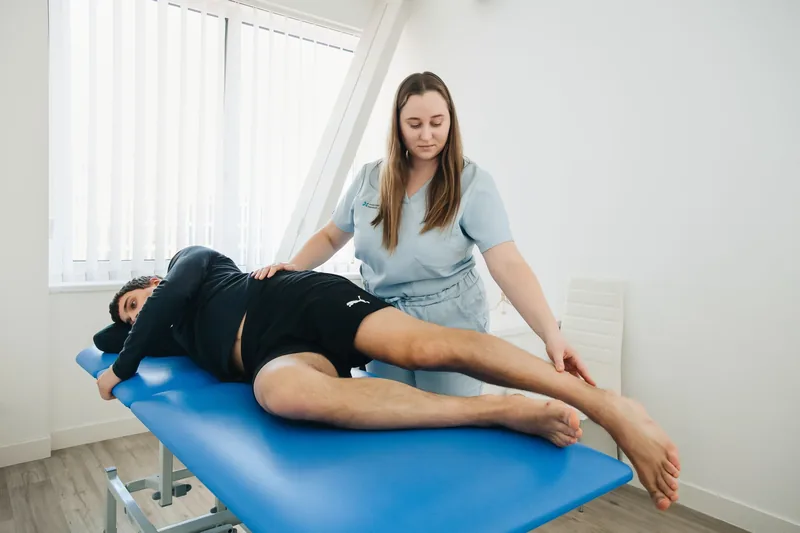

— EDS and hypermobility care
Tell us what your body is doing.
Answer three quick questions and get $50 off your first visit. Someone from our team calls you back, answers your questions, and sets up an exam built around hypermobile joints.
- ✓ Gentle, low-force care. No forceful cracking of loose joints.
- ✓ Chiropractic, stabilization rehab, and functional medicine under one roof
- ✓ Southside Jacksonville and Orange Park
Prefer to call? Jacksonville (904) 379-9412 · Orange Park (904) 541-4826
Questions, answered.
Steadier joints start with a plan.
Gentle, EDS-aware care in Southside Jacksonville and Orange Park. Tell us what your body is doing and we will build a plan around it.
Request an EDS visit